Fields and pasture
Hay ground that has gone to weeds, pasture growing up in brush, and food plot or hunting ground that needs to be opened back up before it turns into woods.
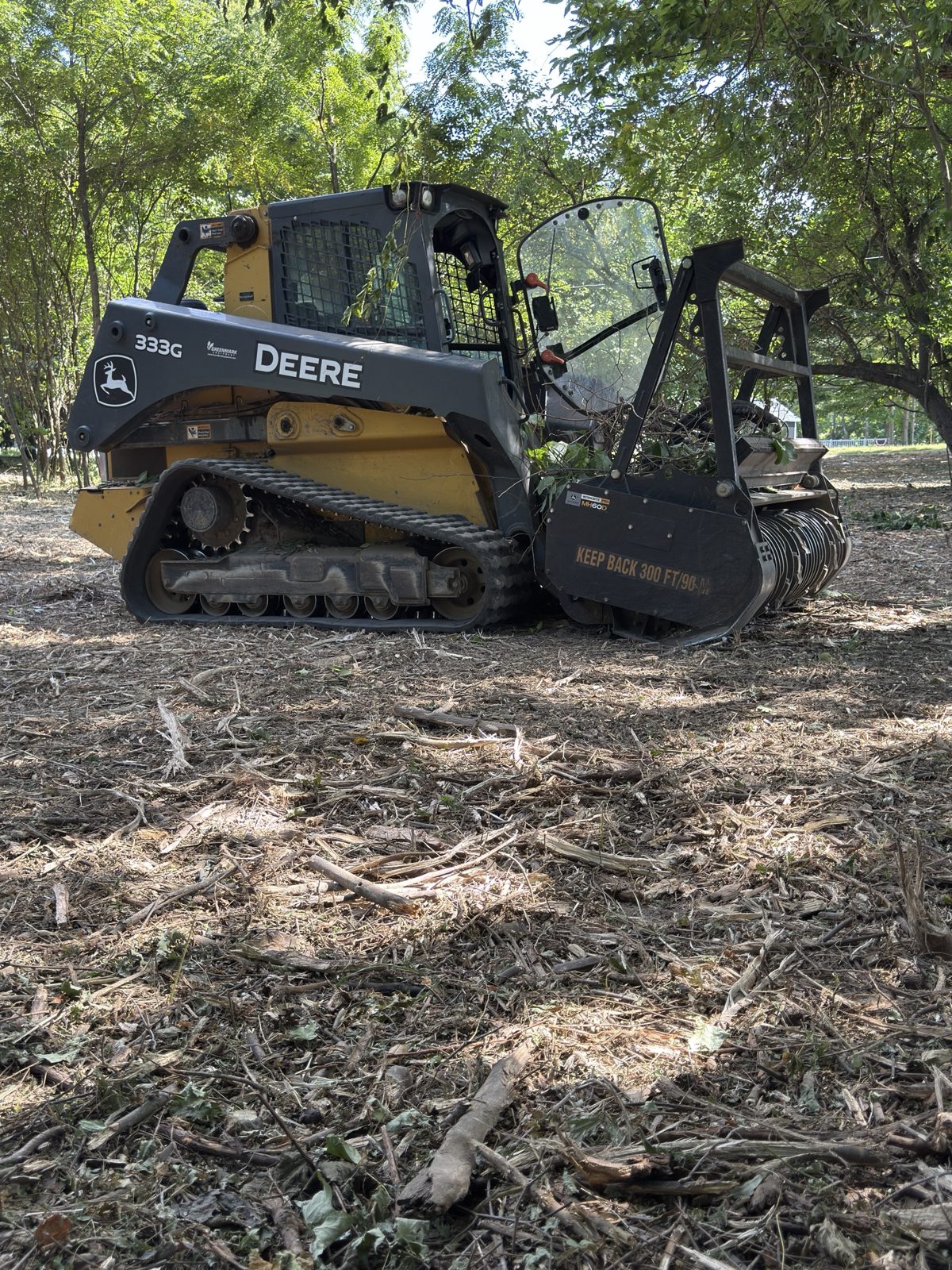
Tall grass, weeds, brush, and saplings cut down so you can see, use, and maintain your ground again. Fields, vacant lots, pasture, trails, and fence lines.
Walker Precision Excavating brush hogs overgrown fields, vacant lots, pasture, trails, and fence lines within about 70 miles of Constantine, Michigan, in both Michigan and Indiana. Josh Walker runs a John Deere 333G compact track loader, which stays on top of soft and uneven ground that stops a wheeled tractor.
Ground that sits for a couple of seasons does not stay grass. Weeds go to seed, brush moves in from the edges, and saplings come up where you used to mow. Brush hogging knocks all of that back to the ground in one pass so the property is usable again.
We run a John Deere 333G compact track loader. Tracks spread the weight, so the machine works on soft bottoms, slopes, and rough ground where a tractor and pull behind cutter would rut or get stuck.
Most calls are one of three jobs. A field or pasture that got away from somebody, a vacant or inherited lot that needs to be cleaned up, or fence lines and trails that have closed in. We handle all three, one time or on a regular schedule.
Hay ground that has gone to weeds, pasture growing up in brush, and food plot or hunting ground that needs to be opened back up before it turns into woods.
Inherited property, lots waiting on a sale or a build, and ground that has drawn a notice from the township. Cut down so it can be shown, surveyed, or maintained.
Fence rows that have swallowed the fence, trails you can no longer drive, and field edges creeping inward a few feet every year.
Brush hogging is the right tool for grass, weeds, brush, and small saplings. It is fast and it covers a lot of ground in a day. The cuttings stay where they fall and break down on their own.
Once the growth is mostly woody, with thicker brush and standing trees, forestry mulching is the better fit. It grinds the material into mulch instead of just cutting it off. A lot of properties need some of each, and we can tell you which after a look.
Every job is quoted after we see the ground or good photos of it. These are the things that change the number.
A site visit or good photos, plus what you want the property to be used for.
A clear number for the area we agreed on, before anything gets cut.
Grass, weeds, brush, and saplings cut to the ground with the track loader.
We go over the finished ground and talk about what it takes to keep it that way.
Brush hogging is mowing overgrown ground with a heavy rotary cutter built for tall grass, weeds, brush, and small saplings. It is the standard way to reclaim fields, lots, and trails that a lawn mower or a finish mower cannot handle.
Most open ground stays in good shape when it is cut once or twice a year. Ground that has been let go for several seasons usually needs one heavier first cut, then regular upkeep after that.
Often, yes. Our John Deere 333G runs on tracks, which spread the weight and keep it working where a wheeled tractor would rut or sink. If the ground is too wet to cut without damage, we will tell you and schedule around it.
No. Brush hogging cuts growth off at the ground. Stumps and roots stay. If you need stumps gone, that is stump grinding, and we do that too.
They are left where they fall and break down. On most fields and lots that is exactly what you want. If you need the material removed, tell us up front and we will quote it that way.
Yes. We work within about 70 miles of Constantine, Michigan, which covers St. Joseph and Cass counties in Michigan and the South Bend, Elkhart, and Goshen area in Indiana.
Last updated November 2026.