Overgrown acreage
Back lots and old pasture that have filled in with brush and saplings. Mulching takes it back to open ground you can mow and maintain.
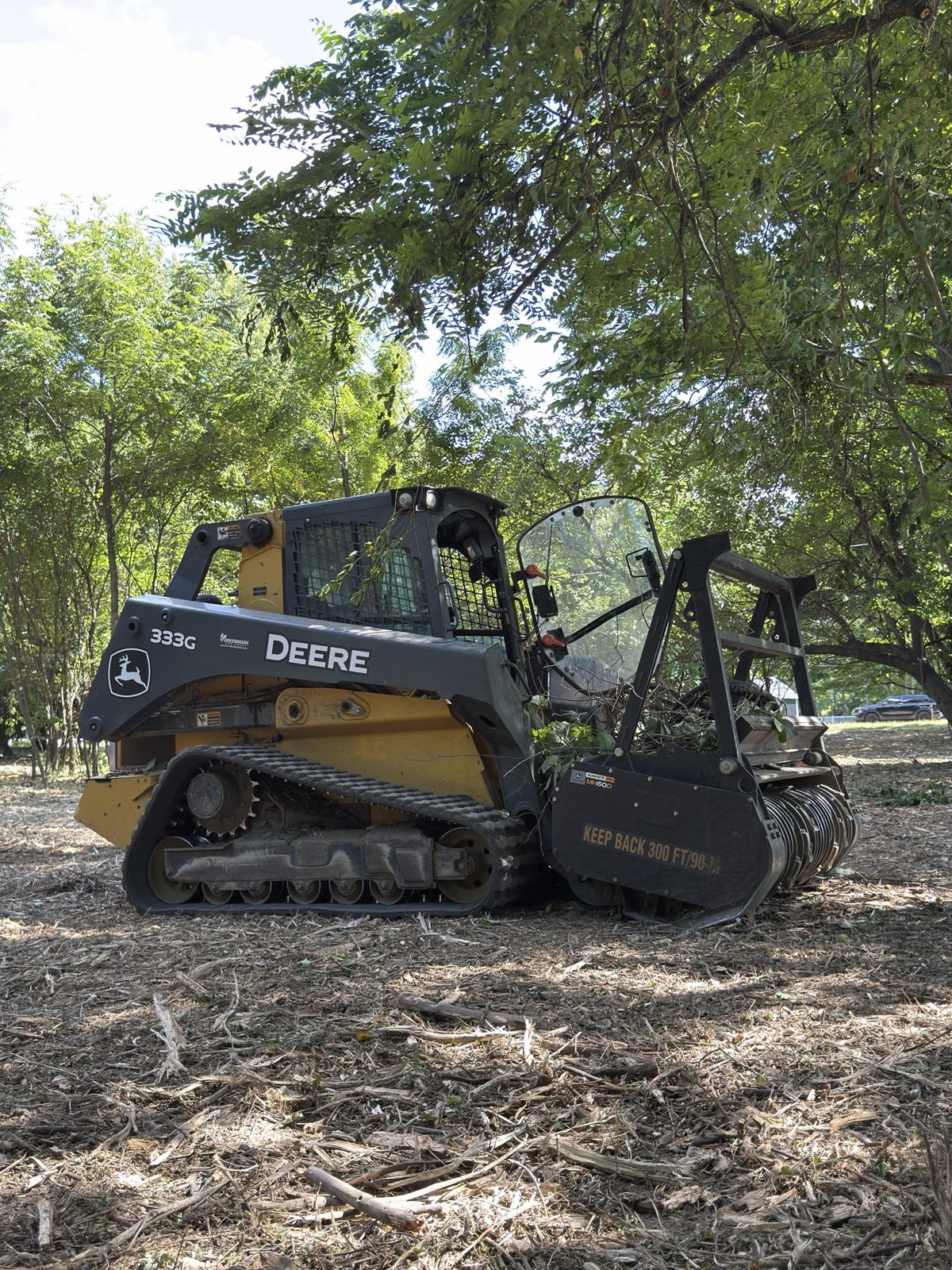
Thick brush, saplings, and small trees ground into mulch right where they stand. No burn piles, no hauling, and far less torn up ground than clearing with a dozer.
Walker Precision Excavating does forestry mulching within about 70 miles of Constantine, Michigan, on both sides of the state line. Josh Walker clears brush, saplings, and small trees with a John Deere 333G compact track loader, grinding the material into mulch that stays on the ground. There is nothing to burn and nothing to haul.
Forestry mulching is land clearing with one machine and no debris pile. A mulching head grinds standing brush and trees into chips and spreads them across the ground as it goes. When the machine leaves, the area is open and walkable the same day.
Because the roots and topsoil are left in place, the ground holds together. That matters on slopes, along water, and anywhere you do not want a mud field for the next year.
It is the right call when you want ground opened up but not stripped. Overgrown woods edges, fence rows, trails, hunting property, and back acreage that has filled in with brush you cannot walk through.
Back lots and old pasture that have filled in with brush and saplings. Mulching takes it back to open ground you can mow and maintain.
Autumn olive, buckthorn, honeysuckle, and multiflora rose take over fast in this part of Michigan and Indiana. Mulching knocks down the whole stand at once.
Driving trails, shooting lanes, property lines, and fence rows cleared to the width you want, with the good trees left standing.
Both open up ground. They leave it in very different condition, and the right one depends on what happens to the property next.
We quote mulching after we see the ground. These are the things that set the price.
We look at what is growing, what you want kept, and what the ground is for afterward.
Keeper trees, property lines, and anything buried get marked before the machine starts.
Brush and trees are ground into chips and spread across the ground as we go.
We walk it with you and clean up the edges so the finished ground looks intentional.
Forestry mulching is a land clearing method where a single machine with a mulching head grinds standing brush, saplings, and small trees into wood chips and leaves them on the ground. There is no burning and no hauling.
Brush hogging cuts grass, weeds, and light brush off at the ground. Forestry mulching grinds woody growth, including thick brush and small trees, into mulch. Brush hogging is for fields. Mulching is for ground that has started turning into woods.
It takes growth down to about ground level, but the stump and roots stay in the soil. For building sites and lawns where stumps have to be gone, that is stump grinding or full land clearing.
It stays on the ground as a layer of chips. It holds the soil, slows regrowth, and breaks down over time. If you are planning to seed, tell us and we will talk through how to leave it.
Some of it will try, especially invasives like autumn olive and buckthorn. Mowing or brush hogging the area once or twice a year after mulching is what keeps it open.
Mulching is meant for brush, saplings, and smaller trees. The practical limit depends on the species and the site, so we look at what you have and tell you what gets mulched and what should be cut and handled separately.
Yes. We work within about 70 miles of Constantine, Michigan, which includes the South Bend, Elkhart, and Goshen area along with Southwest Michigan.
Last updated November 2026.